
European Leagues members endorse 2026-27 Strategic Priorities aimed at furthering the development of football
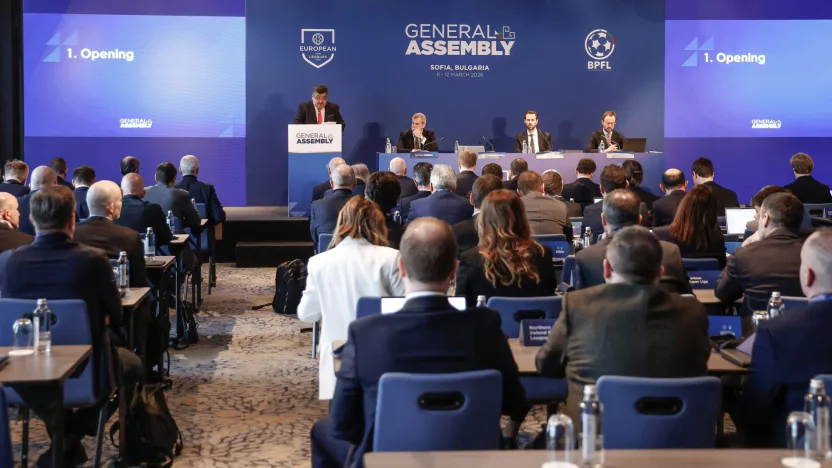
The 52nd General Assembly of European Leagues, saw representatives from 35 Leagues meet in Sofia, Bulgaria for two days of detailed discussions covering a wide range of critical matters relating to the development of football. The gathering which marked the 1st General Assembly of the new cycle (2025-29) under the leadership of Claudius Schäfer welcomed senior representatives from UEFA and FIFA alongside officials from European Leagues sister organisation World Leagues Association, EFC, UEC, FIFPro and FSE.
Members and stakeholders address key challenges and opportunities facing the game
Day 1, saw participants attend a seminar covering the relationship between the domestic and international game and league development matters. Detailed exchanges took place on topics including the ongoing impact of the UEFA Club Competition revenue distribution model on domestic football, the effects of the growth of international competitions on both domestic football’s broadcast market and its calendar and the continued need to consider how to strengthen cost control mechanisms. There is increasing concern that the growth of international competitions is leading to polarisation across the game which undermines competitive balance in many leagues. This worrying trend places at risk the long-term development of domestic football and its foundational position on which the game’s rich traditions were designed and its future development depends.
General Assembly begins with addresses by European Leagues President Claudius Schäfer and EU Sports Commissioner Glenn Micallef
The formal part of the General Assembly began on the morning of 12 March and saw European Leagues’ President Claudius Schäfer open proceedings by reiterating the importance of strengthened unity within the organisation as a means to advance the cause of common objectives based around aligned interests. His full speech can be found here.
This was followed by an address from European Commissioner for Sport Glenn Micallef who highlighted the need to protect the position of domestic leagues as the foundations on which the pyramid is built stressing the importance of achieving balance across the ecosystem as a means to sustain the European Sport Model. In seeking to address issues the game faces, he called on football to strengthen its governance model to ensure greater stakeholder involvement across decision-making and made clear his willingness to support efforts to combat piracy which continues to undermine important revenue streams needed to support the game’s development at all levels of the pyramid.
Members unanimously endorse Strategic Priorities for the coming phase
The main part of the agenda focused around the European Leagues 2026-2027 Strategic Priorities which were unanimously endorsed by Members. The priorities are based around five core pillars which are defined as follows:
- Addressing growing polarisation across the game to preserve competitive balance
- Re-enforcing governance as a means to deliver optimal decision-making
- Enacting a legislative framework to combat piracy
- Strengthening industrial relations through an ongoing commitment to the Social Dialogue both at European and global level
- Securing the future of the European Sport Model
The full Strategy can be found here.
“Theelaborationofthisstrategyhasonesimpleaim–tosecurefootball’ssustainablefuture.AtatimeofrapidevolutionforthegameandsocietymorewidelyweseethreatsandchallengesemergingthatriskunderminingEuropeanfootball’sdevelopment.Ourfocusoverthenextcoupleofyearswillbearoundthesestrategicprioritieswhichwebelieveformthecriticalelementsonwhichthegame’ssustainablefuturedepends.Deliveringonthesewillhelpsecurebalanceacrossfootball’seco-systemandensurefuturegenerationsofplayersandfanscancontinuetobenefitfromtheverybestthebeautifulgamehastooffer.WelookforwardtoworkinginaconstructiveandcollaborativemannerwithUEFA,FIFA,NationalAssociationsandfellowstakeholdersinmeetingourresponsibilitiesasguardiansofthegame’sbestinterestsandcontinuedsuccess.”European Leagues President Claudius Schäfer
Adoption of statutory changes to see professional women’s leagues join the Association
In what was a historical moment for European Leagues, members adopted statutory changes which will open up membership to professional women’s leagues from across Europe. The changes will also see the Board expand allowing for formal representation of the women’s game in European League’s main decision-making body.
“ThisexpansionoftheEuropeanLeaguesmembershiptoincludewomen’sleaguesisofgreatsignificancefortheorganisation.Atatimeofrapidevolutionforthewomen’sgameitiscriticalthatthevoiceofwomen’sdomesticfootballisanorganizedandunitedonewhichcancarryweightandinfluenceacrossdecision-making.ThroughmembershipofEuropeanLeagues,women’sleague’swillbeableoffervaluableinputaroundthedevelopmentoffootball.ThisisamomentofveryrealprideforEuropeanLeagueswhichwillseeitwelcomenewmemberstoitsfamilyinthecomingmonths.”Fiona McIntyre Chair of the Women’s European Leagues Platform